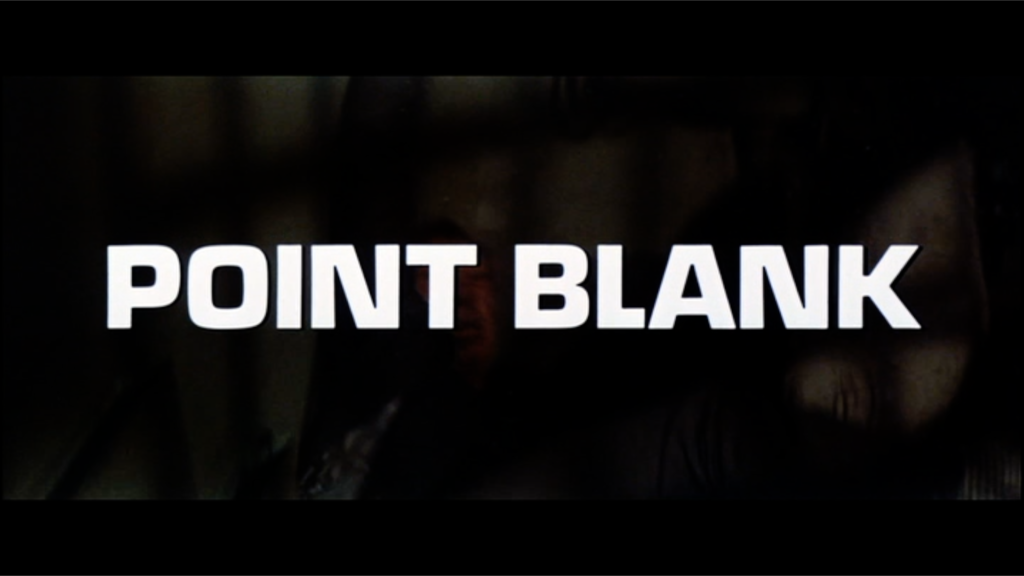
Three criminals, two men and a woman, plan a heist on a scheduled money drop on Alcatraz Island. After the robbery, one of the men, Mal Reese (John Vernon), turns on the other, Walker (Lee Marvin), shooting him twice in the stomach and leaves with both the money and the woman, Lynne (Sharon Acker), who is Walker’s wife. Yet, Walker survives and, aided by a mysterious stranger called Yost (Keenan Wynn), who seems to know all about Walker and the heist, sets out to take revenge on both Lynne and Reese and to claim the $93,000 he is owed for the Alcatraz job. Whilst the former proves no problem for a man such as Walker, the latter is complicated by the money being tied up in the organisation Reese belongs to. Aided by Lynne’s sister, Chris (Angie Dickinson), Walker inexorably moves further up the chain of command, eliminating them one by one in his relentless pursuit of his money.
This, then, is the plot to Point Blank, John Boorman’s remarkably assured and boldly experimental Hollywood debut, released on the cusp of New Hollywood in 1967. In someone else’s hands, it might have been just another generic revenge thriller. Indeed, if you want to see that film, go watch Payback (1999), a remake of Point Blank starring Mel Gibson as Walker. But Boorman had no interest in shooting a generic revenge thriller, looking instead to bring a European sensibility to the Hollywood thriller, combining the ruptures of time and space of Alain Resnais and the alienation and empty spaces of Michelangelo Antonioni with the brute force of Sam Fuller. The effect is palpably dreamlike: repeated flashbacks, shock cuts, elliptical editing, minimal dialogue, stunning widescreen compositions, and sudden bursts of violence. As such, I find myself drawn not so much to the story but to moments, of scenes, images, and gestures. Moments which, perhaps, don’t cohere into a fully satisfying whole, at least in terms of the kinds of stories we’re used to being told, but which spark the film into life. What follows are three such moments, of scenes that I keep returning to, and which seem to go beyond their narrative usage to speak of cinema, of how we respond to and what we expect from a film.
Walker is approached by Yost onboard a ferry tour of Alcatraz, who gives him the address of Lynne’s apartment in Los Angeles. We then cut to Walker striding along a corridor at LAX, purposeful, determined, ferocious, his footsteps heightened on the soundtrack as he marches towards the camera. Boorman dubbed this sequence “Walker’s coming to get you” and it’s easy to see why. As Walker continues along the corridor, Boorman cuts to Lynne in bed, seemingly awakened by the sound of Walker’s footsteps. The rest of the sequence follows this pattern, cutting repeatedly between Walker, marching down the corridor, then driving, before stopping outside his estranged wife’s apartment, and Lynne, who is seen getting dressed, putting on her make-up, visiting a hair salon, and arriving back at her apartment, all to the sound of Walker’s thunderous footsteps. The sound of the footsteps stops only when Walker bursts through the door of Lynne’s apartment, throws her onto the floor, kicks open the bedroom door and fires off six shots into her empty bed.
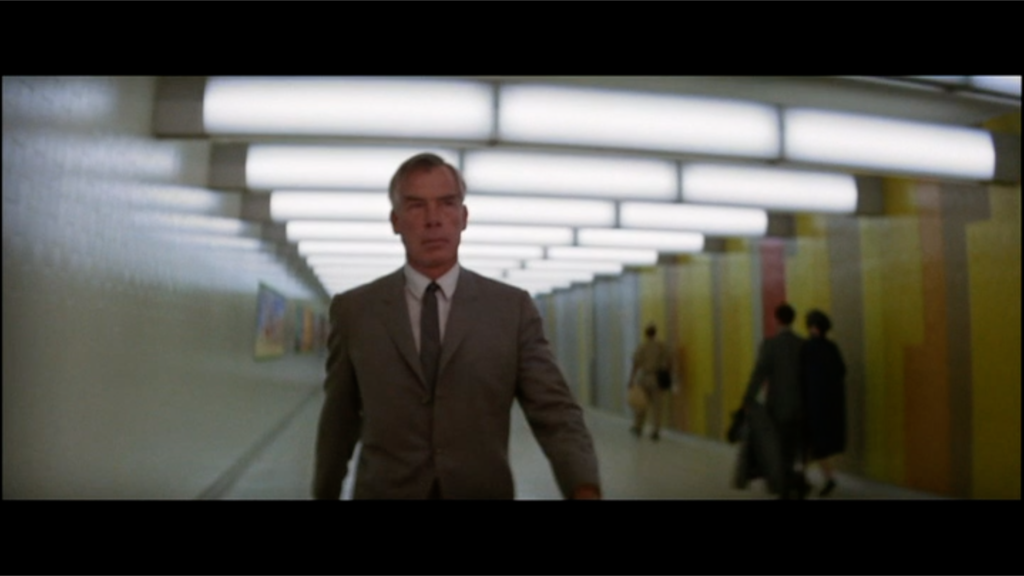
When Mr. Blonde wryly remarks to Mr. White in Reservoir Dogs (1992), “I bet you’re a big Lee Marvin fan,” this is the Marvin he infers. Marvin as alpha male, whose presence oozes masculine authority and toughness. When I first saw Point Blank thirty years ago, during my first flush of cinephilia, I was left stunned by this sequence, not only by Marvin’s sheer presence, but also by its artistry. Few people rave about montage nowadays, but this sequence, edited by Henry Berman, is one of the great examples of montage, condensing time and space to create a visceral experience whilst moving the story forward. Montage, for me, is cinema. It offers what no other medium can: to tell a story, create an emotion, or express an idea through discontinuous moving images, which, when projected, create the perception of continuity in space and time. To have watched this sequence thirty years ago and see it rarely bettered in the years since has been a source of bitter disappointment to me. If Hitchcock mastered Hollywood montage in the 1950s then Point Blank offered something new and modern, a bold, experimental style that played with space and time to suggest the fractured mind of its tough hero. The year of Point Blank’s release is revealing in this sense: 1967 and the birth of New Hollywood, which, following the collapse of Old Hollywood, ushered in a modernist and reflective cinema which challenged the old myths and conventions, took up many of the stylistic innovations from European art cinema, and which celebrated and revitalised genre cinema. We know how this story ends; with the return to well-worn myths, to spectacle, and to the huge box-office of Star Wars (1977) and its like. In this sense, the montage in Point Blank feels like an aberration, of a path ultimately not taken by Hollywood.
When I first saw Point Blank, I, like many I’d wager, was pulled in by Marvin’s oneiric performance as Walker. Walker is tough and threatening, but so cold and detached as to be almost somnambulistic. He is neither cruel nor compassionate, and displays no pleasure or satisfaction from vengeance. He is, as Obi-Wan Kenobi would put it, more machine now than man. When Walker strides through LAX, he could be a precursor to the Terminator. He can’t be bargained with. He can’t be reasoned with. He doesn’t feel pity, or remorse, or fear. And he absolutely will not stop. It is Chris’s role in the film to help Walker recover his humanity, to make him more man than machine. If I was drawn to Walker at first, in the years since, I’ve find myself thinking more about Chris. It isn’t just that she is beautiful, but that she seems to light up the screen, in her vivid yellow and orange dresses, in contrast to Walker’s monochrome wardrobe. And she is the only character that seems to become more alive as the film progresses, complicating Walker’s revenge fantasy by demanding that he feels something, not only for her, but also for himself. Walker may be back from the dead, but it is Chris who seems to bring him, and the film, to life.
Chris, startled by the sudden appearance of her sister’s ex-husband, presumed dead, has been convinced by Walker to act as a decoy so that he can get revenge on Mal Reese. Visiting Reese in his penthouse suite, Chris offers herself for his pleasure, thus distracting Reese so that Walker can slip in unnoticed. When Walker appears, Chris jumps out of bed, grabs her yellow dress and runs to the bathroom to get dressed. The camera, though, stays in the bedroom with Reese and Walker, who drags Reese out of bed at gun point and starts to demand the money that Reese took from him. Yet, Chris remains in shot, relegated to the background, and sometimes obscured by both men, as she dresses in the bathroom with the door left open. Chris may be visible in the scene, but the moment Walker appears in Reese’s bedroom, she becomes surplus to the narrative, her role diminished as Walker takes charge, reasserting himself as the male protagonist who drives the narrative forward. Chris walks out of the bathroom, pausing briefly to look at Walker throwing Reese over a chair and then walks out of shot, leaving us alone with Walker.
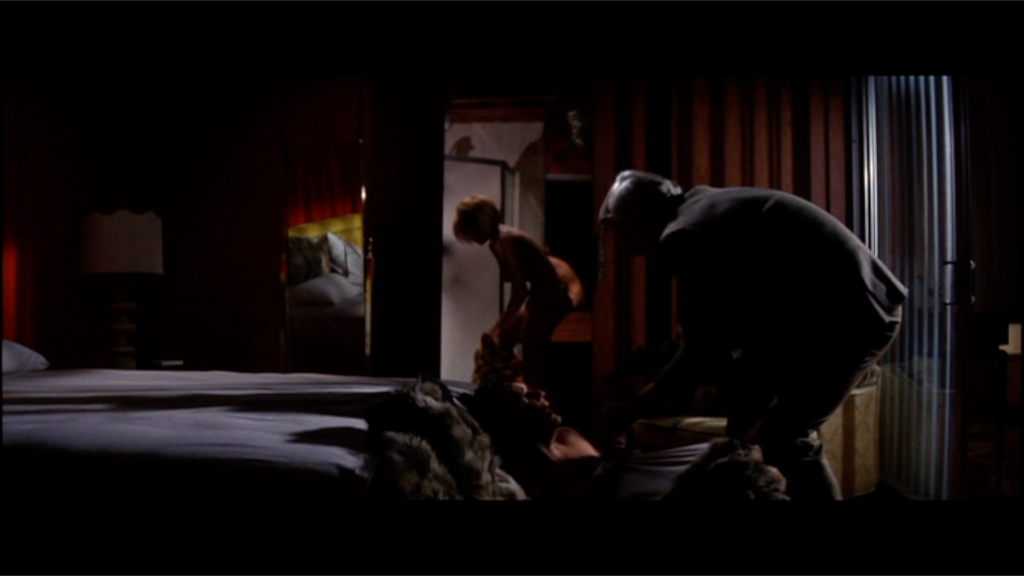
Chris might become secondary to the narrative the moment Walker appears, but the fact that she is still visible in the scene, in half-naked silhouette, allows a moment of distraction from the action taking place in the foreground. And once distracted, a question might pop into your head. What is Chris thinking as she changes into her dress? She has just allowed a man she despises to touch and caress her body so that another man she barely knows can get his revenge. Is this the moment Chris realises exactly what she has been asked to do? She is now, after all, an accessory to murder, at least as far as the mob is concerned. Does she really think there’ll be no reprisals? Does she think that Walker will look after her? After Reese has fallen to his death from the balcony of his penthouse suite, Walker meets up with Chris outside the hotel, pays her off for services rendered and coldly dismisses her from the narrative. But convention dictates that the tough hero must have a love interest lest audiences fail to emotionally connect to a man more invested in violence and revenge than a beautiful woman. So Chris will later be dragged back into the story, not because she refuses to be dismissed so easily, but because Walker will decide he wants her there after all. Such, it seems, is the lot of the woman in these tough Hollywood thrillers.
Chris gets pulled back into the plot when Walker visits her apartment, only to find it trashed, punishment for helping Walker get to Reese. Walker then asks Chris to come with him. Is he, as Chris suggests, asking her on a date? Is he feeling guilty over using Chris and putting her in danger? Chris, in effect, misreads Walker’s intentions as romantic. Maybe we do too, so used are we to seeing the tough hero need a lover. Walker takes Chris firstly to a diner then to a spectacular house up in the Hollywood hills. We already know that this house belongs to the mob, to another syndicate boss who Walker will threaten to kill unless he gets his money. Once Chris figures this out, she wonders why she’s there. Why is Chris here, in this film, apart from that Angie Dickinson looks great in a yellow or orange dress? She is certainly pivotal in helping Walker get to Reese, but does Walker really need her help? The “Walker’s coming to get you” montage is so visceral, so dynamic, that I doubt anyone would need to suspend their disbelief in seeing Walker march into the Huntley Hotel and take out Reese and his henchmen, especially that soon after Walker has apparently needed Chris’s help, he’s back being a bad-ass, walking into a syndicate building, barging into Carter’s office, threatening him, and dragging him out of the building. Chris is there because she represents something more wholesome than violence, money or revenge. She is the ‘good’ woman, who sees in the tough hero a tenderness that we struggle to see. Countless women in countless tough thrillers have played out this thankless role, being browbeaten, threatened, ignored, and dismissed, all so that we and the tough hero can get our happy ending.
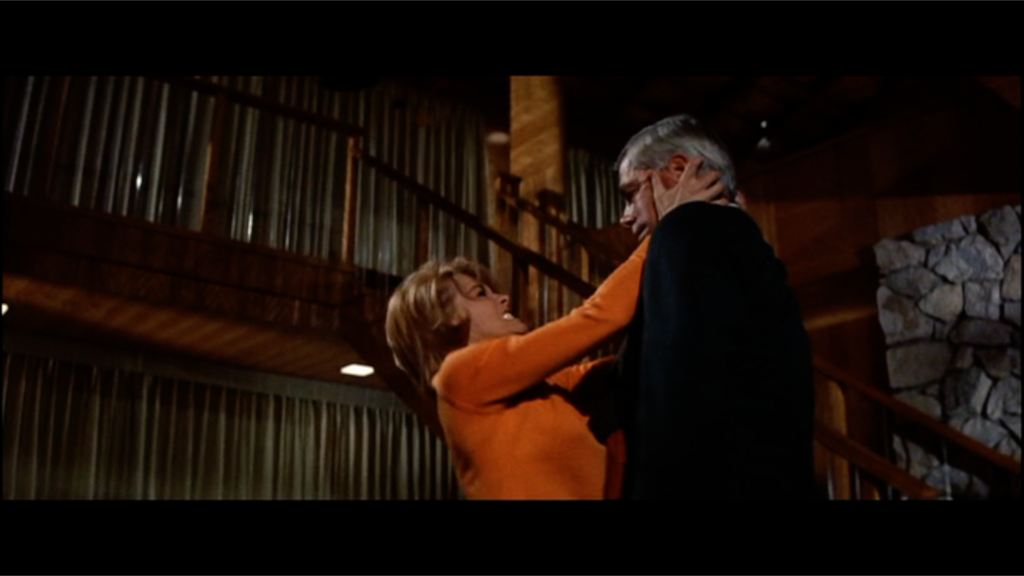
Chris is with Walker, he informs her, because she’ll be safer with him than not. Whilst this is almost certainly true, it also implies that he does actually care about her, but Walker, like all tough heroes, can’t admit that he’s gone soft. “What do you think this was, a pitch?” Walker derisively asks Chris, “Forget it.” What follows is one of the most astonishing moments in Point Blank. “You forget it!” Chris snaps back before unleashing a flurry of punches, slaps, and swings of her handbag at Walker, who, after blocking the first couple of swings, just stands there, impassive and immovable, letting Chris tire herself out. And boy, does she let rip. In this moment, Chris expresses the anger and frustration of all the ‘good’ women that have been subservient to the tough hero. This is a scene I’ll always remember for my mother walking in at that moment, kept watching until Chris slumps exhausted to the floor and then said to me, “You know, I’ve often felt like that with your father,” a stark reminder of the very real frustrations many women have not only to be seen and heard, but also understood. This scene, then, is a reminder that even the ‘good’ woman might have her limits, but would the tough hero listen? Walker listens and offers Chris what he thinks she wants. They have sex. And then? Walker dismisses her once again.
Or does he? Perhaps Walker takes Chris up to San Francisco and to Fort Point just as Brewster suggests? Only we don’t see Chris at Fort Point and we don’t see Walker meet up with her after. Instead, he retreats back into the shadows, the money still waiting to be collected. Walker, then, could have had both the money and the woman, but chose neither. Might this explain why many have latched on to a dream reading of the film, that this is all the fever dream of a dying man bleeding out from a gunshot wound in a prison cell on Alcatraz? How else to explain why Walker doesn’t get his happy ending, walking away with the loot and the girl? And if that is what you wanted then maybe Walker isn’t the only one who is dreaming?
Leave a Reply