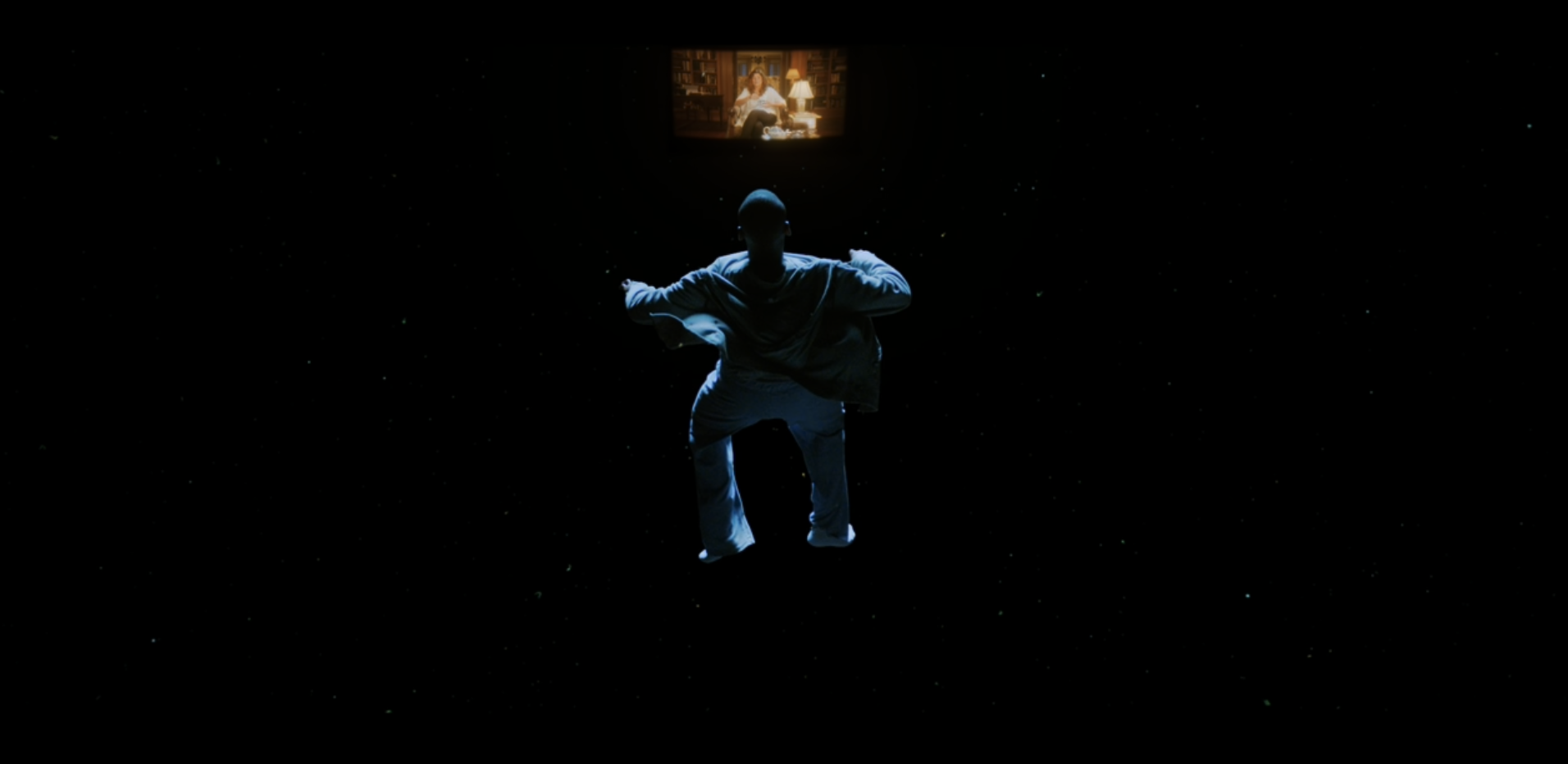
In 1983, during his “Delirious” stand up tour, Eddie Murphy delivered a routine highlighting the difference between how a black family would react to moving into a haunted house as opposed to how a white family would. The pay off was that as soon as a black family heard an ominous voice telling them to get out, they would be straight out the door whilst the white family would stick around, the implication being that blacks are more attuned to noticing such a threat whilst whites are blinded by their privilege and entitlement. When Chris (Daniel Kaluuya), the black hero of Get Out, hears those words himself, he too decides it’s time to get out, only by then it is too late, partly because Chris has no idea that he is actually in a horror film.
Of course, getting out at the earliest opportunity wouldn’t make for much of a horror film. Horror films, like all genre movies, have their own set of conventions: a rural or isolated setting; a sense of unease created by a series of strange or unsettling events; the use of extreme close-up shots to convey fear; slow, lingering shots to wrack up tension; abrupt editing that defies continuity to provide a sudden shock or scare; villains that are able to survive traumatic injuries; and sudden, intense, and sometimes prolonged, bursts of violence. Get Out plays with all these conventions, but it’s not this familiarity that makes the film so enjoyable, it’s how Peele rewrites the horror film by using these conventions to emphasise a black American cultural perspective.
Chris misreads all the signs in the film as simply his everyday experience of navigating white privilege and prejudice. Essentially a thriller reworking of Guess Who’s Coming to Dinner (Stanley Kramer, 1967), Get Out begins with Chris being invited by his white girlfriend, Rose (Allison Williams), to spend the weekend upstate to meet her rich, liberal parents, Dean (Bradley Whitford) and Missy (Catherine Keener), who show no reaction to him being black. His unease over this is heightened by a series of strange and unsettling events, all of which Chris fails to fully grasp: Rose arguing with a policeman when he demands to see Chris’ ID after they have been involved in a roadkill accident is not righteous anger, but actually to stop any paper trail; the black maid, Georgina (Betty Gabriel), who keeps switching his phone off isn’t taking issue with Chris being in an interracial relationship, but is in fact making sure he cannot contact anyone; Rose’s brother, Jeremy (Caleb Landry Jones), who keeps praising Chris’ physique, is not just playing up to black stereotypes, but is also accessing whether he can take Chris down if he has to; Missy’s offer to help Chris quit smoking through hypnosis is actually to prepare him for the ordeal to come; and the garden party full of old, rich white people where he meets another black man, Andre (Lakeith Stanfield), who acts and dresses like those around him, is not just an embarrassing display of white privilege, but actually an auction where Chris is the prize.
It is when he meets Andre that Chris finally realises that things are not what they seem. After failing to engage with Andre, Chris takes a photo of him, sensing that something is wrong, but the flash of the camera sends Andre into a panicked rage, screaming at Chris to get out. It is only then when Chris tries to leave that the full extent of the horror is revealed. Rose and Jeremy have been recruiting unwilling black victims for old or disabled wealthy white folk to have their brains swapped, a procedure performed by Dean, who handles the operation, and Missy, who deals with the therapy by hypnotising her victims and keeping their subconscious buried. Such a hysterically B-movie premise is reminiscent of The Thing with Two Heads (Lee Frost, 1972), in which Ray Milland’s racist surgeon has his head transplanted onto the body of Rosey Grier’s death row convict, a black man, so that Milland can continue living as his health is deteriorating. Made at the height of the Blaxploitation craze, the film teeters unevenly between comedy and horror, yet a critique of racism emerges as Grier struggles with Milland for control of his own body.
As The Thing with Two Heads demonstrates, a B-movie with a ludicrous plot can still contain a nugget of truth: that the black man is still fighting for his own autonomy. So, too, does Get Out, its absurd plot only helps to highlight the core themes which underpin the film – black cultural identity, black incarceration, and the hubris of white liberalism – as Chris enters a world of terrifying whiteness with its legacy of slavery and anti-black violence that wants to strip him of his autonomy and freedom. The former Black Panther Eldridge Cleaver essentially described the plot of Get Out fifty-years earlier when he wrote of the race/class structure in America, “the white man wants to be the brain and… wants us to be the muscle, the body,” whilst warning of the danger of white liberalism, suggesting “any liberality the Omnipotent Administrator (the white man) might show… is itself a part of his lust for omnipotence.” Peele started writing Get Out during the Obama presidency as a response to the notion that the race problem had somehow been fixed simply by electing a black president into the White House. Yet, the post-racial era that the election of Obama was perceived to usher in was shattered by the election of Donald Trump as President of the United States, based on a campaign of hatred and mistrust, whose divisive rhetoric ripped open all the old wounds on race, leading to a rise in hate crimes and emboldening far-right groups to march through the streets.
It is this cultural resonance that gives Get Out its real power, where any scene could reference not only other horror films, but also the horror of real life. The opening sequence where Andre is walking through a white suburban neighbourhood at night, deserted except for a lone car that keeps appearing, before being attacked and choked unconscious, is a homage to Halloween (John Carpenter, 1978), but it also explicitly references the murder of Trayvon Martin, a 17 year-old black man who was subdued and shot dead by a neighbourhood watch, George Zimmerman, as he walked through the gated community where he was staying with his father’s girlfriend and her son, moaning to his girlfriend on the phone that all the houses look the same. Zimmerman was never charged with any crime, being deemed to have acted in self-defence. Trayvon Martin never got the chance to get out.
Chris does get out after unleashing violent retribution on his captors, his years of subdued anger and frustration being given cathartic and righteous release. As he leaves a trail of dead bodies behind him, though, Chris is confronted by the wailing sirens of a police car. Peele’s original ending had Chris in prison, his explanation falling on deaf, blinkered ears. This downbeat ending was reminiscent of Night of the Living Dead (George A. Romero, 1968), in which the black hero, Ben (Duane Jones), survives the zombie onslaught only to be shot dead by the white militia who are clearing the area of zombies and mistake Ben for one, throwing his lifeless body on top of a pile of zombies and set alight. With this ending, Night of the Living Dead caught the cultural zeitgeist of the late-1960s, of race riots, political assassinations, student protests, police brutality, black radicalism, and the Vietnam war. Get Out is nowhere near as apocalyptic, but no less redolent of the racial anxieties that continue to grip the United States: structural inequality; Black Lives Matter; police brutality; the prison industrial complex; white supremacy; and the failure of neoliberalism. In this sense, the original ending that left Chris incarcerated seemed to be the spiritual successor to Romero’s film. The connotation is clear: being a black man in 1968 was brutal and in 2017, it isn’t much better.
This nod to Night of the Living Dead was not unintentional; in interviews he gave upon the release of Get Out, Peele frequently referenced three films which could be considered a triumvirate of racial horror: Night of the Living Dead; Candyman (Bernard Rose, 1992); and The People Under the Stairs (Wes Craven, 1991). By placing Get Out alongside these films, Peele was not only explicitly naming his film as racial horror, but also highlighting how few horror films have dared to project race as the site of contemporary horror. Both Candyman and The People Under the Stairs were also included in a selection of horror films and thrillers that Peele curated on the eve of the release of Get Out entitled “The Art of the Social Thriller,” along with Rosemary’s Baby (Roman Polanski, 1968), Guess Who’s Coming to Dinner, The Stepford Wives (Bryan Forbes, 1975), Funny Games (Michael Haneke, 1997), The Shining (Stanley Kubrick, 1980), and Silence of the Lambs (Jonathan Demme, 1991). Peele used the term “social thriller” as a means of differentiating such films from generic horror films and thrillers, arguing that the social thriller had a strong social context embedded in it that placed society itself as the bogeyman. The original ending of Get Out was certainly in keeping with this notion, with Chris being fated to fail due to the colour of his skin. Yet, Peele would reshoot the ending after test screenings proved negative. In the reshot ending, the police car is revealed to belong to Chris’ TSA buddy, Rod (LilRey Howery), who has come to rescue his friend after recognising Andre from the photo Chris sent him. Cue the cheers as Peele gives the audience what they want. Racism has been defeated and the black man lives on.
It would be easy for me to dismiss this ending, to claim it as a cop-out, a reluctance to follow the narrative towards its authentic conclusion. After all, Peele confirmed what many had figured out, that the sunken place referred to in the film was a metaphor for the disproportionate number of black men incarcerated in the United States. In the film, the sunken place describes an induced hypnotic state that buries one’s consciousness so that they have no control over their own body. With Chris in custody, Get Out would have delivered a bleakly ironic and painfully truthful ending in its original form. Yet, Peele’s argument for changing his ending has always been that black audiences needed an escape from the crushing despair of racism. Who am I to disagree with that? And I can’t deny how palpable the sense of relief is when Rod steps out of the police car. Perhaps Peele knew all along that the reshot ending would never completely erase the original. It still exists, if only in the viewer’s head, who inevitably plays out that ending, even without prior knowledge of it, as soon as Chris hears the siren approaching. Peele decided to save Chris, figuring that in the current cultural climate, audiences needed to cheer a black hero now more than ever. Chris was lucky; he was given a second chance to get out. Not everyone does.
Leave a Reply