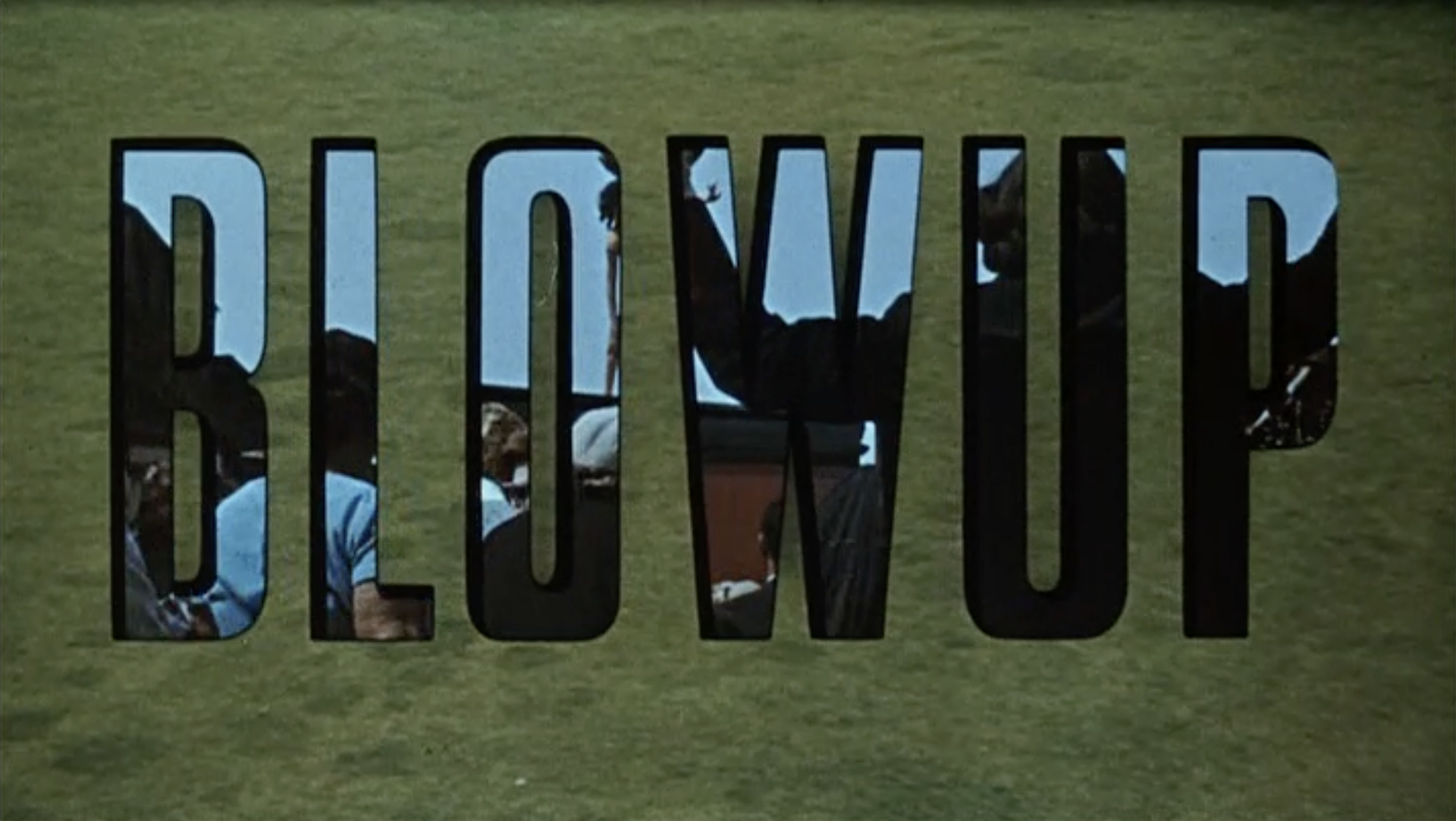
Released at the tail end of 1966, though most audiences would see it in 1967, Blow-up was nothing short of a sensation. Yes, Blow-up provided a brief glimpse of Jane Birkin’s pubic hair, and contributed to ending the Hollywood Production Code, an antiquated mode of censorship that had been in effect for thirty years, but more than that, Blow-up captured a specific moment in time. An English-language film made by a celebrated Italian director, Michelangelo Antonioni, Blow-up provided a snapshot of London in the throes of the “swinging sixties,” a zeitgeist-defining era which was as much fiction as fact. It’s hard to believe now, but all roads led to London back then, as the city established itself as the centre of fashion, art, and music. As a cine-tourist, both to London and to British culture, Antonioni was clearly fascinated by the sexual and creative freedom he encountered, immersing himself in the London arts scene, assembling a then contemporary who’s who of creative talent in and around the film: the fashion photographer David Bailey provided the inspiration; another photographer John Cowan provided his studio, which became Thomas’ studio in the film; the model Veruschka appears in the first photo shoot at Thomas’ studio; the reportage photographer Don McCullin took the photos in Maryon park; the abstract oil paintings of Thomas’ artist neighbour Bill were created by Ian Stephenson; and the band that plays in the strangely static club are The Yardbirds. At the same time, though, Antonioni displays a marked ambivalence over how exhilarating creative and sexual freedom really is, hinting at an aimlessness and disaffection in his characters which are often masked by a performance of cool detachment. No surprise there really; Antonioni had made his name with a trilogy of films which pointed to the relationships between men and women as a metaphor for an aimless and disaffected modernity, only this time Antonioni introduces a plot, a murder mystery in which a trendy fashion photographer, Thomas (David Hemmings), unwittingly witnesses a crime and has to piece together the evidence.
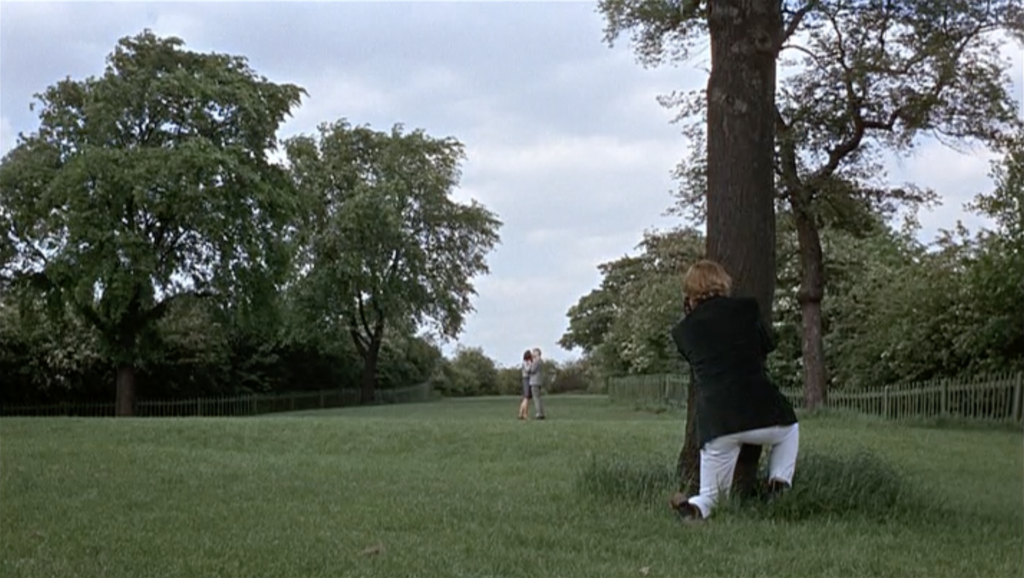
All roads might have led to London back then, but few would have ventured as far as Maryon Park in Charlton, situated in southeast London. And yet it is here in this unassuming park that one of the great moments in cinema – a striking scene if there ever was one – takes place. To set the scene, Thomas has driven to Charlton to visit an antiques shop that his agent wishes to buy. The owner is not there, but she’ll be back soon enough so Thomas wanders into a nearby park to kill some time. As he amuses himself, skipping along the path taking photographs of this peaceful idyll, Thomas catches sight of a couple, an older man and a younger woman (according to the credits, her name is Jane, played by Vanessa Redgrave), laughing and flirting with each other. Thomas follows the couple as the woman leads the man up some steps to a more secluded area of the park. There he begins to take photos of the couple as they stand by a tree in the centre of the lawn, framed by the trees and bushes on each side – perfect, he thinks, as an image to finish a collection of photographs for a book Thomas plans to publish which captures the ‘real’ London, a final image to juxtapose the violence of the poverty captured in his other photographs. Thomas is soon spotted by the couple. He begins to walk away. The woman chases after him and confronts Thomas. What gives him the right to take her picture without her consent, she asks, before demanding that Thomas gives her the roll of film. Thomas refuses. She tries to snatch the camera but Thomas pushes her away. They both notice that the older man has disappeared. As she begins to flee, Thomas again snaps away, watching her briefly pause by the tree in the centre of the lawn, before continuing on. Amused by the incident, Thomas walks back to the antiques shop.
We don’t know it yet of course, but we have just witnessed the pivotal narrative event of Blow-up. Something happened in this scene that we, and Thomas, are not privy to. What follows is Thomas’, and our, realisation of what actually took place. And once we think we’ve figured it out, the narrative then collapses in on itself, denying us any kind of closure or resolution. Alfred Hitchcock much admired Blow-up, at least for a time, repeatedly rewatching the film in preparation for what he hoped to be his next project, then titled Kaleidoscope, but which would eventually be released as Frenzy (1972), by which point, Hitchcock had soured on Blow-up and of the new wave cinemas of the 1960s in general. It’s tempting to think of how Hitchcock might have approached the scene in Maryon Park. Would he have given us all the clues if only we had cared to look? But I wonder if Hitchcock would have placed as much emphasis on the sound of the wind in the trees as Antonioni does? Each time I watch Blow-up, the sound of the leaves rustling in the wind delights me. I have visited Maryon Park, retracing Thomas’ footsteps, and looked at the same tree in the centre of the lawn. And there I stood, transfixed, as I heard the wind in the trees.
What is it about the wind in the trees that causes such giddiness? D. W. Griffith once lamented, “what the modern movie lacks is beauty – the beauty of the moving wind in the trees.” Georges Méliès was inspired to become a filmmaker after seeing Repas de bébé (Baby’s Meal), one of ten short films screened by the Lumière brothers at the Grand Café in Paris in 1895, in which Méliès was struck by the sensation of seeing the leaves rustling in the wind behind Auguste Lumière, his wife and his infant daughter. Reports of that famous screening noted how the audience was delighted by such marginal details: the leaves swaying in the wind, the smoke from a hot iron being plunged into water, and waves crashing in the surf. Such anecdotes speak not only of the potential of cinema – as art, as documentary, as a striking scene – but also of an ontology of cinema, of how the real shimmers through the staged illusion performed for the camera. This was Andre Bazin’s argument, that the film camera automatically captures an image of the world free of any creative intervention, an image which cannot be fully contained in the staged reality of the film. It is a stretch, perhaps, to suggest that Antonioni was hinting at such an ontology when he captured the leaves swaying in the wind in Maryon Park, but he was clearly struck by the sensation, recording the sound separately and overlaying it in post production. Antonioni wanted us to not only see the leaves swaying in the wind, but also to hear them. The question, then, is why? As a metaphor, the wind in the trees describes a presence, not seen as such, but felt. As he wanders through Maryon Park, Thomas misreads this presence as peaceful when, in fact, the wind whistling through the trees signals something more menacing, the prelude to murder. Filmed mainly in long shot, Thomas is confronted by nature, the antithesis of the manufactured reality he inhabits and has helped to create, an illusion of ‘Swinging London’ constructed through images of beauty, glamour, fashion, and consumerism. His belief in surface appearance will be his undoing. Thomas thinks he has captured a beautiful image only to discover that he has captured something horrific, a detail that he didn’t see at the time.
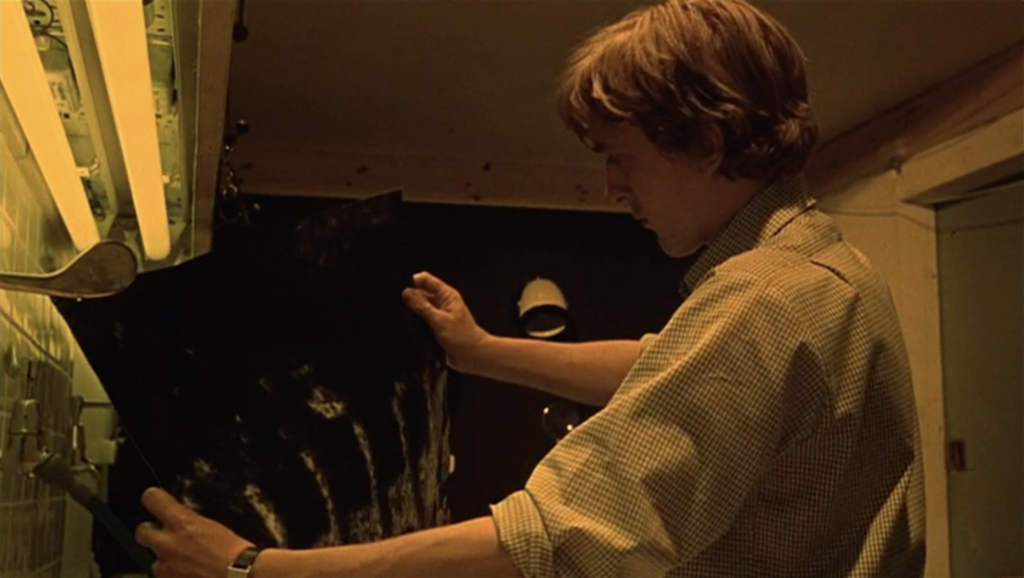
Thomas is compelled to look again at his photographs of Maryon Park by Jane’s insistence in demanding he give her the roll of film. Thomas refused her the first time only for Jane to appear at his studio and, again, demand the roll of film, eventually offering to have sex with Thomas in exchange. Her dignity is saved by the arrival of the propeller Thomas bought at the antiques shop on a whim and hurriedly leaves with a different roll of film given to her by Thomas. But now Thomas is intrigued. Thus begins what is the most celebrated sequence of Blow-up, a ten-minute tour-de-force as Thomas methodically develops the roll of film, cutting each negative of the shot he wants, placing it into the enlarger, projecting the shot onto a sheet of photographic paper, submerging the sheet in the developing tank, and then hanging the blow-up onto the wall of his studio. Thomas repeats this process, scrutinising each blow-up in turn. A detail attracts him in the photo of Jane embracing the older man. Her expression seems wrong. Instead of an intimate moment between two lovers, Jane is distracted, her gaze focused elsewhere. Thomas returns to a wider shot of the couple, tracing Jane’s line of sight, and starts to print blow-ups of the original blow-ups, enlarging a portion of the image, until he discovers through the grainy, almost abstract patterns of each subsequent blow-up what might be a man hidden in the bushes holding a gun.
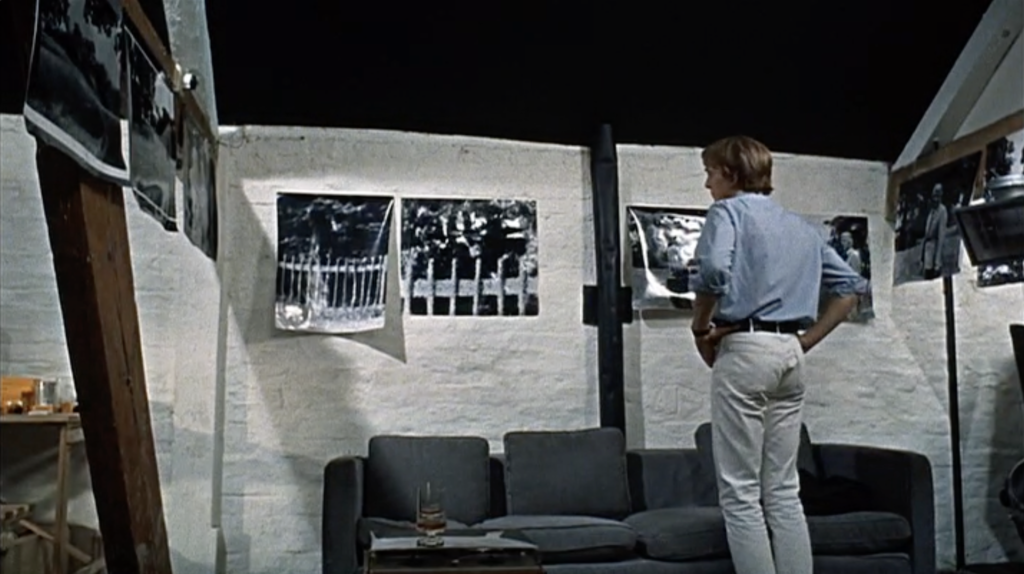
Thomas arranges his prints along the walls of his studio, moving them around until he has succeeded in reconstructing the event which took place in the park. He then stands back and the camera pans across each still image in turn, pausing for a few seconds before moving onto the next as the narrative in the park unfolds, replete with the sound of the wind in the trees. The first print is a long shot of Jane pulling the older man by the arm as she leads him towards the tree in the centre of the lawn; the next is a long shot of the couple embracing; then a close-up of the couple, in which Jane is looking off-screen; an enlargement of a man hiding in the bushes; an extreme enlargement of what seems to be the man holding a gun; Jane notices Thomas; both her and the older man looking towards Thomas; the older man on his own, looking uncertain; Jane in close-up, looking pensive; Jane confronting Thomas on the steps, covering her face with her hand; Jane then standing alone in long shot by the tree in the centre of the lawn; an enlargement of Jane, her expression suggests that she has seen something unusual; a long shot of the empty park after she has fled.
Here, then, is the artist in his element, displaying a mastery of his craft, at one with his tools and his environment, revealing step by step the process of photography, from roll of film to blow-up. For a brief moment, Thomas is more alive, more animated, in this scene than at any other point in the film. Few films have portrayed such artistic and technical process so methodically, so exhilaratingly. And in doing so, Antonioni allows us a peek behind the curtain, so to speak, to reveal the process of filmmaking, of taking a reel of celluloid film, selecting which shots to use, cutting the film into pieces and splicing them back together to create a series of images which form a narrative. Yet, it is one of potentially many narratives available to the filmmaker. Choose a different shot or rearrange the sequence and a different narrative might emerge. Thomas’ carefully selected reconstruction has been to thwart a murder. He has, in effect, created a narrative in which Thomas is the hero, whose intervention has saved a man’s life. But is this what actually happened?
As befits the hero, Thomas is soon rewarded for his endeavours with the arrival of two young women hoping to kickstart their modelling careers. This interruption serves two purposes: firstly to remind us that Thomas’ forte is not taking pictures in a park or thwarting murders, but is instead photographing beautiful women. And secondly, however one wishes to define a hero, Thomas ain’t it. He is rude, arrogant, and vain. He is detached, easily distracted, unable to relate to others, and treats his models, if not all women, with contempt. What follows is a ‘playful’ threesome which blurs the boundaries between coercion and consent, a reminder, if anyone needed it, that however liberating the swinging sixties may have been, male power and privilege continued unabated. And to ram that message home, the threesome ends with the wannabe models dutifully dressing Thomas, putting his socks and shoes on and tying his shoe laces.
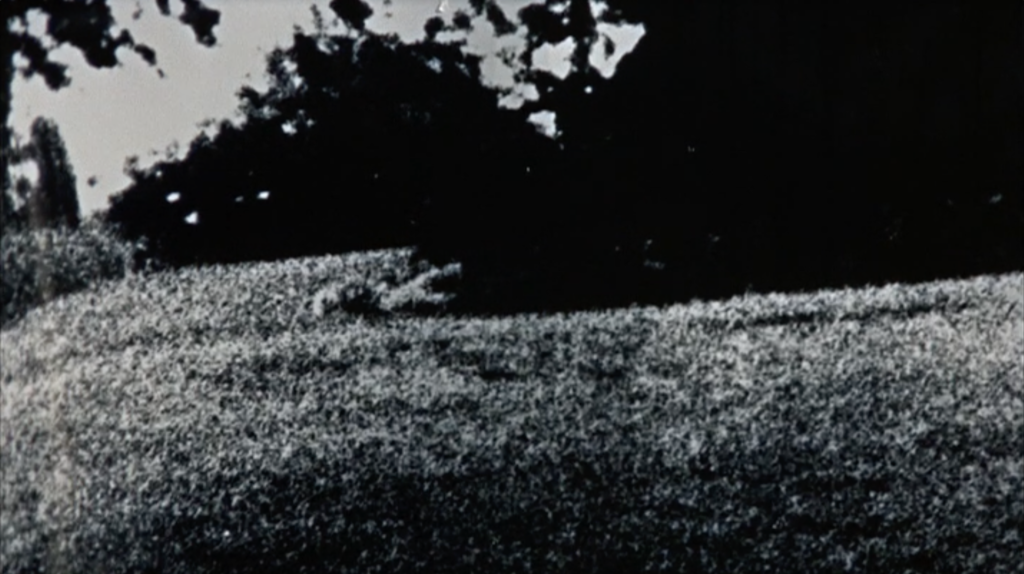
But if this is Thomas’ reward, it costs him dearly. Whatever authority and privilege Thomas had soon deserts him. Roused from his reverie (what is that threesome if not a fantasy?) Thomas looks again at the sequence of blow-ups and is attracted to a detail in the final print. Thomas rushes to his darkroom, but is soon overcome, slowing to a stop and reaching out to the wall as if he is about to topple over. Might Roland Barthes have been thinking of Blow-up when he wrote in Camera Lucida, “this distortion between certainty and oblivion gave me a kind of vertigo, something of a detective anguish”? Certainly, Thomas seems to experience the kind of vertigo that Barthes describes, his certainty over what he had first seen in the photographs suddenly giving way to the oblivion of what he thinks he sees in the final print. Thomas has seen a shape, barely visible, behind the tree in the centre of the lawn. Could it be a dead body? Thomas enlarges the image twice, each becoming more grainy and abstract until his final blow-up more closely resembles one of his artist neighbour Bill’s abstract paintings than a photograph. His first blow-ups had led him to believe that he had saved a man’s life simply by being there, but Thomas had been looking in the wrong place. His euphoria turns to despair as his carefully constructed narrative collapses. He will go back to the park and see the body for himself, but without his camera, without proof that the body was ever there. By the time Thomas returns to the park with his camera, the body will be gone, his studio trashed and the photographs and roll of film taken. All he will be left with is his final abstract blow-up, a mad image of thousands of grainy dots which Thomas knows is a dead body but can never prove it.
With his passion and excitement gone, and his chance to be a hero denied him, Thomas is left a broken man. But being a hero is hard work, you have to be active not passive, know right from wrong or at least recognise the true value of what you see, and impose yourself onto the narrative. What you don’t do is get distracted, give up and get stoned. Antonioni’s heroes were never up to the task, too self-obsessed, too passive, too busy in the throes of a crisis of identity. Hitchcock’s hero would have made a better job of it. One of the reasons Hitchcock soured on Blow-up was that he ultimately found the film too pretentious, that it never really went anywhere. Hitchcock, no doubt, would have given us closure and a happy ending, but would we still be talking about that film sixty years later?
Leave a Reply